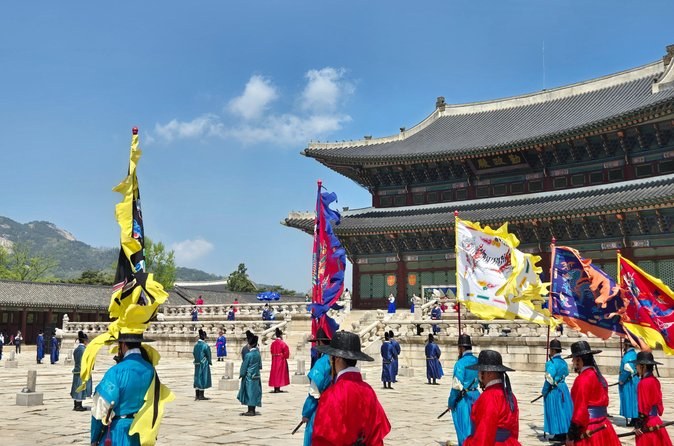
Private Layover Tour from Incheon Airport to Seoul
Airport pickupAdmission includedPrivate
Publishes its own Tuesday swap to Changdeokgung, and carries admission and both transfers inside the fare.
From $240 per person
Gyeongbokgung Palace is on nearly every itinerary here, and it is shut every Tuesday. Nobody expects a national monument to have a closed day, and it reshapes the whole afternoon. Two of these operators already publish their Tuesday swap — one moves to Changdeokgung, the other to Deoksugung.
Which is the part that saves the day. Between the two of them there is no weekday when every royal palace in Seoul is shut, so a Tuesday connection loses one specific building rather than the idea of a palace visit.
Incheon operates transit tours for passengers connecting in 24 hours or less, staffed from desks in Terminal 1 near Gates 1 and 2 and in Terminal 2 across Exit 4. You bring your passport and both boarding passes and turn up half an hour before departure. On a six-hour gap it is genuinely the better option.
Leaving the terminal means entering Korea, which normally needs a visa or a K-ETA. But the K-ETA requirement is temporarily suspended for nationals of visa-waiver countries until 31 December 2026. It is the single most useful fact a Seoul layover traveller can know in 2026, and it carries an expiry date.
Not two ends of one building — two separate buildings, joined by a six-minute train ride costing KRW 1,050 or a shuttle bus of 15 to 18 minutes. If you land at one and depart from the other, that is twenty minutes you had not planned for.
It sits on an island about 60 kilometres west of the city, joined by a bridge. That hour each way is the reason a six-hour layover cannot reach the capital, and the reason the map page exists at all.
The Airport Railroad runs two services on the same line: a non-stop express with reserved seats, and an all-stop service that calls everywhere for noticeably less money. Seventeen minutes is the whole difference, which makes the cheaper one the sensible default unless your margin is thin.
Lunch is an exclusion on almost every listing here, which sounds like a gap and is actually a freedom. At Gwangjang Market you eat standing at a stall in twenty minutes for a few thousand won. A restaurant would have cost you a stop.
Two of them, and it changes the arithmetic entirely. A $254 fare charged once for the whole party is $85 each for three people and $127 each for two. The cheapest-looking number on a list is rarely the cheapest option for your actual party.
It has over 1,700 reviews and costs $68 a head, which makes it look like the obvious pick. It is collected from a hotel in central Seoul by mini-bus. Land at Incheon and you simply cannot take it — unless your stopover includes a night, which is what the long-layover page covers.
Several excellent excursions run from Busan and Jeju, hundreds of kilometres south, for cruise passengers rather than air passengers. They are properly rated and honestly priced; they are simply a different city. Read where a tour starts before you read what it costs.
Read back through the list and a pattern shows up. The palace closure, the terminal distance, the fifteen kilometres between buildings, the difference between an eight-hour tour and an eight-hour connection — almost all of it is arithmetic rather than culture.
That is the real difference between planning a layover and planning a holiday. On a holiday a closed palace costs you a morning; on a connection it costs you the only stop you had time for. Which is why every best layover tour Seoul option worth booking asks for your flight numbers before it asks anything else.
Almost everything above is a constraint. This one is not: the standard Seoul layover route is nearly all free. The palace costs KRW 3,000 and is usually inside your fare; Bukchon, Insadong, Jogyesa, Gwangjang and Namdaemun cost nothing at all to walk into.
That is unusual for a capital city's headline sights, and it changes what a guided day is actually buying. You are not paying for access, because there is barely any access to buy. You are paying for the route, the timing and someone who knows that the palace is quietest at nine and the market is best at noon — which is a much better thing to be paying for.
| The surprise | What it changes | What to do |
|---|---|---|
| Gyeongbokgung shuts on Tuesdays | Your single main stop | Tell the operator your date; the swap is already published |
| Terminals are 15 km apart | Twenty minutes of your margin | Send both flight numbers, not a terminal |
| The airport runs free tours | Whether you pay at all under 8 hours | Use the desks in T1 or T2 on a short gap |
| K-ETA waived to 31 Dec 2026 | Your paperwork, possibly to nothing | Check the official site against your passport |
| Per-group pricing | Which tour is cheapest for you | Divide the fare by your party size before comparing |
Publishes its own Tuesday swap to Changdeokgung, and carries admission and both transfers inside the fare.
From $240 per person
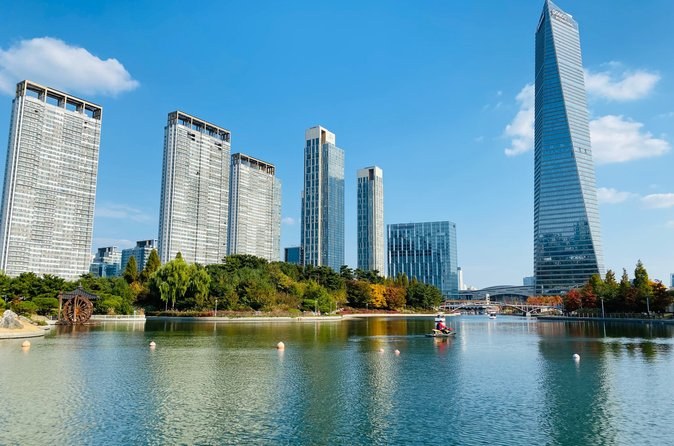
Stays twenty minutes from the terminal instead of an hour — the answer to surprise number six.
From $190 per person
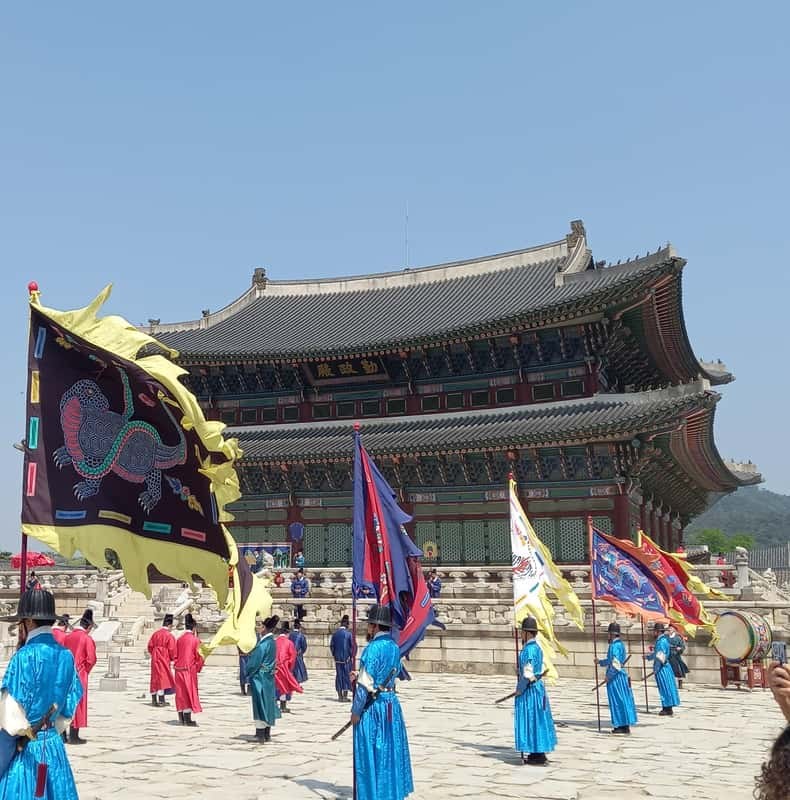
Priced once for the whole group and run on the Airport Railroad itself, which settles both the pricing and the distance questions at once.
From $254 per group
None of these needs to catch you out: the FAQs answer the rest, and the departures are on Seoul Layover Tours.