Short answer. You can absolutely do this alone. Clear immigration, take the Airport Railroad to Seoul Station in 43 minutes, and walk. Below about eight hours that is the right answer, and the airport's own free transit tour is better still. Past nine hours a booked guide starts to earn its fare.
Can you leave Incheon Airport on your own?
Yes, and the process is unremarkable. You clear passport control like any arriving
passenger, walk into the arrivals hall, and go. Coming back you check in, clear security
and depart normally.
The only real gate is permission to enter Korea at all. Staying airside for under 24
hours with an onward ticket needs nothing; leaving needs a Korean visa or a K-ETA. The
useful part in 2026 is that the K-ETA requirement is temporarily waived for visa-waiver
nationals until 31 December 2026. Check the official site against your
own passport.
What does the Airport Railroad actually cost you in time?
Two services on one line. The express runs non-stop to Seoul Station in
43 minutes with a reserved seat. The all-stop takes about an hour and
calls everywhere, for noticeably less money.
Seventeen minutes is the entire difference. Unless your margin is thin, the cheaper
service is the sensible default, and it puts you in the same place.
How far is Seoul Station from the things you came to see?
Closer than the numbers suggest. From Seoul Station, Gyeongbokgung Palace is a short
metro ride or about ten minutes in a taxi. Namdaemun Market is walkable. Insadong and
Bukchon sit within a few streets of the palace, which is why the standard route works on
foot once you are there.
That compactness is the reason a self-guided Seoul layover is genuinely feasible in a
way it is not in every capital. The stop list has the walking
distances.
What about the airport's own transit tours?
Incheon runs them itself, free, for passengers connecting in 24 hours or less. Sign-up
desks are in Terminal 1 near Gates 1 and 2 and in Terminal 2 across Exit 4. Bring your
passport and both boarding passes, and arrive half an hour before departure.
Eligibility covers passengers from visa-free countries, holders of US, Canadian,
Australian, New Zealand or European visas transiting Korea, and transiting foreign
nationals generally. On a short connection this is not a lesser option; it is the
sensible one.
Train, bus, taxi or tour?
| Channel | Time to central Seoul | What it handles | What it leaves you |
|---|
| Airport Railroad express | 43 minutes | The journey, on time | Route, timing and entry fees, all yours |
| Airport Railroad all-stop | About an hour | The journey, cheaply | The same, plus more stations |
| Airport bus | About an hour | A direct run to many districts | Traffic risk, and your own return timing |
| Metered taxi | About an hour | Door to door | The fare each way, and the traffic |
| Airport transit tour | Fixed slots | Route, guide and transport, free | No say in where you go |
| Booked private guide | About an hour | Route, timing, entry fees and the return leg | The fare, from $185 a head |
What does a guide actually add that a ticket cannot?
Four things, and only one of them is commentary.
An edited route. Four stops in the right order, with the palace at
09:00 and the market at noon, rather than a list you assemble on a phone.
Entry fees already paid. Small money, but it removes a decision at
every gate.
A return leg timed to your flight. The operators ask for both flight
numbers and work backwards. Doing that yourself is possible and it is the part people get
wrong.
Someone who knows the traffic. Which matters most on the return, when
being wrong is expensive.
When is doing it yourself clearly better?
- Under eight hours. There is time for one thing. A fixed free tour, or
the train and one place, does that perfectly well.
- When you have been before. The value of an edited route falls to
almost nothing once you know which streets you want.
- When the budget is the constraint. The train and your own feet cost a
few thousand won against $185 upward.
- When you want to sit in one place. Nobody needs a guide to spend
three hours in a tea house in Insadong, and it is a fine way to spend a layover.
When is a booked guide clearly better?
- Nine hours or more. Four or five stops and a real ordering
problem.
- Travelling with children, or with someone who cannot walk far. A
private day bends around that; a fixed departure cannot.
- A first visit to Korea with a tight return. Having someone else watch
the clock is worth the fare on its own.
- Arriving by ship. The deadline is a sailing time, and the cruise
excursions state an on-time return as part of the fare.
What do you actually need to carry?
Less than you would think. Cards work almost everywhere including the train and taxis,
so a modest cash withdrawal at the airport covers market stalls. Signage and announcements
on the Airport Railroad and at the palaces are bilingual throughout.
Leave the big bag at a left-luggage counter or take it on the tour vehicle; do not take
it on the train at rush hour. Everything else on
the planning page.
How hard is Incheon to navigate on your own?
Unusually easy, and this is the fact that makes the do-it-yourself option genuinely
competitive here. The airport is consistently rated among the best-run in the world.
Signage is bilingual throughout, the train is a single line with two services and no
changes, and the arrivals halls funnel you to the same place.
The one thing to establish before you land is which terminal you are in. Terminal 1 and
Terminal 2 are separate buildings 15 kilometres apart, joined by a six-minute train ride
at KRW 1,050 or a shuttle bus of 15 to 18 minutes. If you land at one and depart from the
other, that is twenty minutes to add to your own plan —
the map page has the pick-up points.
What does a self-guided day actually cost?
Very little, which is the honest headline. Two train fares, the palace at KRW 3,000,
and lunch at a market stall for a few thousand won more. Everything else on the standard
route — Bukchon, Insadong, Jogyesa, the markets — is free to walk into.
That is unusual for a capital city's headline sights, and it changes what a guided day
is buying. You are not paying for access, because there is barely any access to buy. You
are paying for the route, the timing and the return leg. Whether that is worth $185 is
entirely a question of how many hours you have.
What can go wrong, and what to do about it
The commonest failure is a late inbound, not a wrong turn. If you are self-guided you simply cut the day short; if you booked, message the operator and they will reshape it. Either way, work backwards from your departure using
the timing rules rather than forwards from your landing.
The second commonest is the palace's Tuesday closure catching someone who planned the
whole day around it. The third is a bag that had to be collected and re-checked because
the two flights were on separate tickets.
What does the return journey ask of you?
This is the half of a self-guided layover that gets least attention and causes most
trouble. Going in, you have as long as you like; coming back, you have a deadline with a
gate attached to it.
Work it backwards. Fix your departure time. Subtract two hours for check-in, security
and departure immigration — three if your tickets are separate and you are checking
in from scratch. Subtract one more for the train or the road. Subtract twenty minutes if
you leave from a different terminal than you landed at. What is left is the time you walk
away from your last stop, and it is usually earlier than people expect.
The Airport Railroad helps here in a way a taxi does not, because it runs to a
timetable rather than to traffic. On the express you know the ride is 43 minutes; in a
car at 18:00 you do not. If you are self-guiding and your margin is thin, take the train
back even if you took a taxi in.
What about the bus, and why does nobody mention it?
Because the train is usually better, not because the bus is bad. Airport buses run from
Incheon to most Seoul districts directly, which saves you the transfer at Seoul Station
that the train imposes — if your target is Myeongdong or Gangnam rather than the
palace, a bus can put you closer to it.
What the bus cannot do is ignore the expressway. Sixty kilometres of road at 08:00 or
18:00 is a different journey from the same road at 11:00, and the timetable does not know
which one you will get. On the way in that is an inconvenience; on the way back, with a
gate closing, it is the reason most self-guided travellers take the train home even when
they took the bus out.
If you are weighing the two, weigh them separately for each direction rather than
picking one for the day.
The honest verdict, by connection length
Under six hours: stay airside. Six to eight: the airport's own free tour, or the train
and one place. Nine to twelve: a booked guide earns the fare. Over sixteen: a hotel, and
then whichever of the two you prefer the next morning.
That is the whole answer, and it is not a sales pitch. The reader who takes the free
tour on a six-hour connection is the same reader who books a private day on the way
home.
If a guide is the right call for your gap
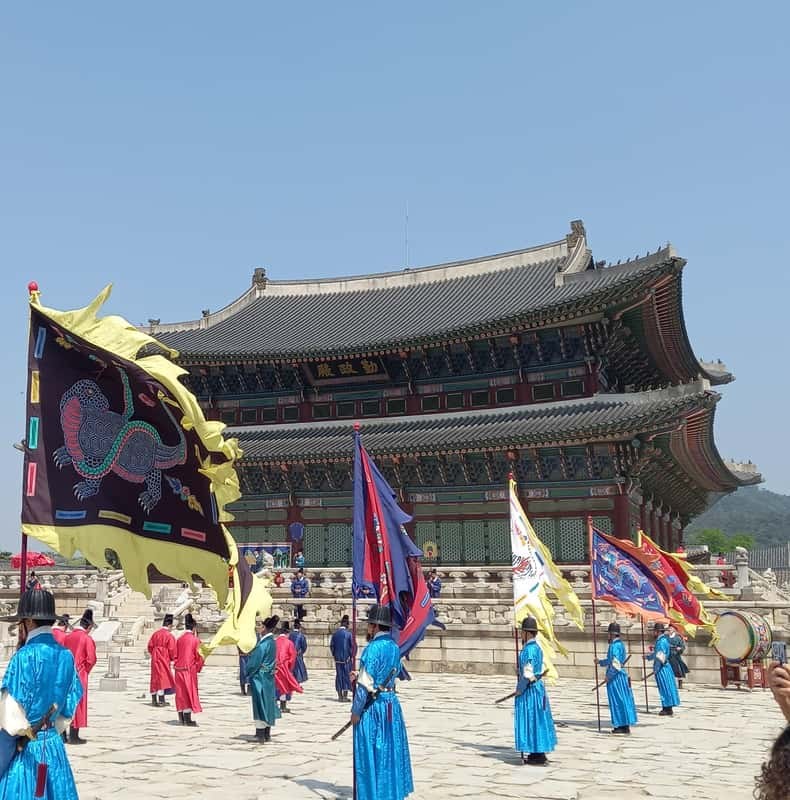
★ 5.023 reviews6 hours
Airport pickupAdmission includedBy train
The closest thing to doing it yourself, done properly — the same Airport Railroad, with someone who knows the palace riding it with you.
From $254 per group
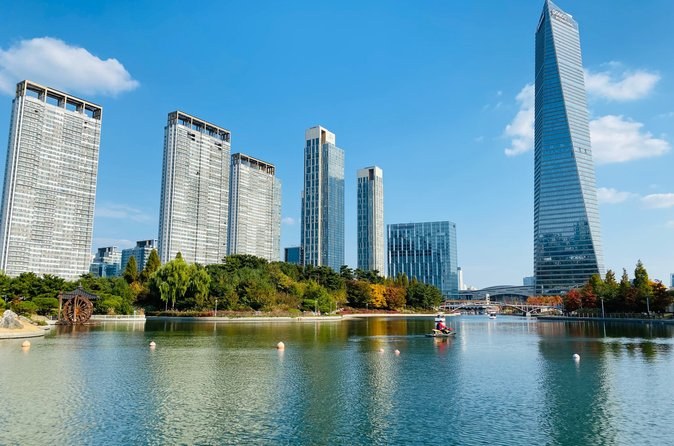
★ 4.948 reviews8 hours
Airport pickupAdmission includedPrivate
For the short connection where Seoul is out of reach: Incheon's own quarter, twenty minutes from the terminal.
From $190 per person
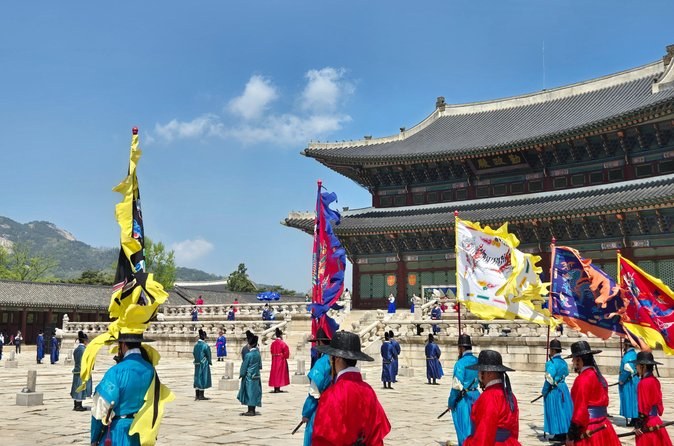
★ 4.984 reviews7 to 8 hours
Airport pickupAdmission includedPrivate
The full nine-hour-plus answer, with entry fees and both transfers paid and the return timed to your departure.
From $240 per person